CSAM Conducts Dialogue on Testing and Certification with Private Sector in Thailand
Meeting Documents
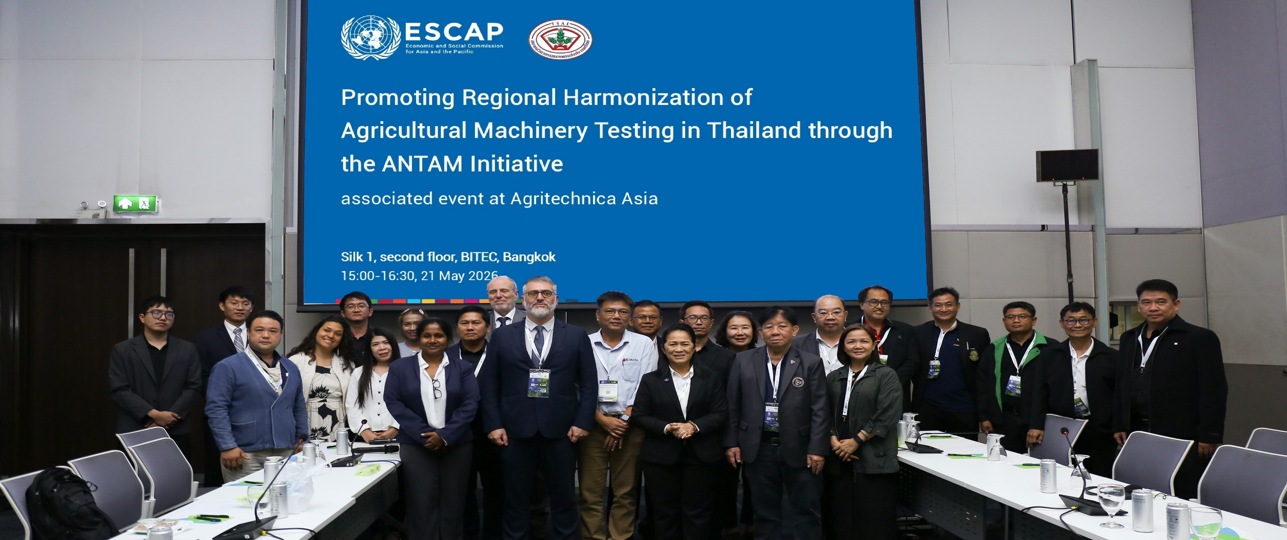
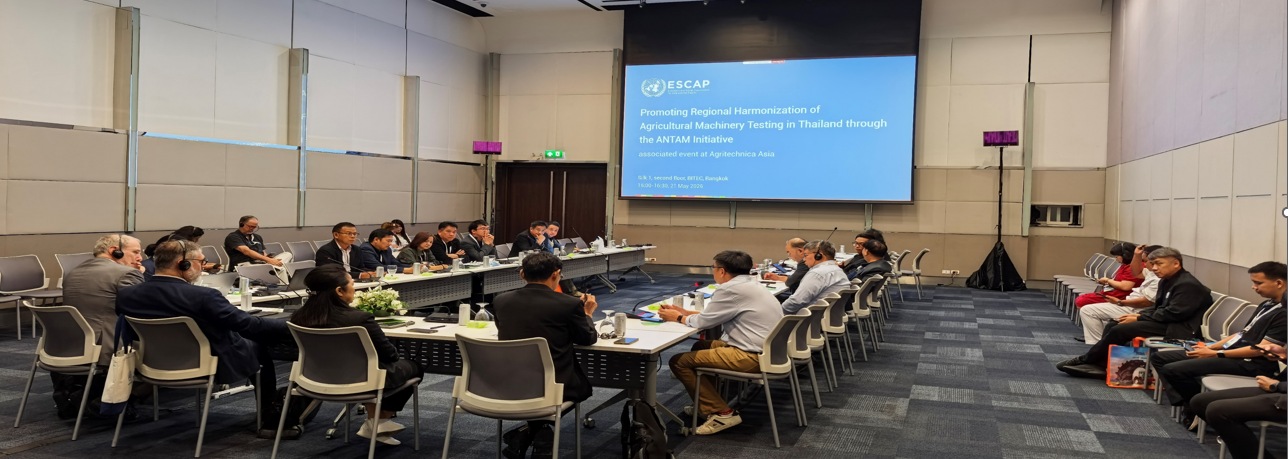
The Centre for Sustainable Agricultural Mechanization (CSAM) of the United Nations Economic and Social Commission for Asia and the Pacific (ESCAP), jointly with the Thai Society of Agricultural Engineers (TSAE) and in collaboration with the Thai Industrial Standards Institute (TISI) and the Thai National Agricultural Machinery Center (NAMC), organized a dialogue titled “Promoting Regionally Harmonized Agricultural Machinery Testing in Thailand through the ANTAM Initiative” on 21 May 2026 at BITEC in Bangkok. The event was held under the framework of the Asian and Pacific Network for Testing of Agricultural Machinery (ANTAM), a regional initiative of CSAM that promotes harmonized testing procedures and mutual recognition of results across the Asia-Pacific region.
Conducted alongside the Agritechnica Asia 2026 agricultural machinery exhibition, the event provided a platform to engage Thai and regional stakeholders on opportunities to strengthen cooperation in agricultural machinery testing and standards harmonization. Particular attention was given to the private sector, including national and international manufacturers and distributors. Discussions focused on the potential benefits of aligning national testing systems with ANTAM codes, including improved product quality, enhanced credibility and market trust, reduced compliance costs, and easier access to regional and international markets.
Following the opening remarks by Ms. Dares Kittyopas, President of the Thai Society of Agricultural Engineers, CSAM, as the ANTAM Secretariat, presented an overview of the testing codes and proposed certification system, highlighting its role in promoting simplified and inclusive procedures developed through a collaborative regional process.
Two discussions sessions focused on the importance of testing of agricultural machinery, and the benefits of participating in certifications schemes. The first round examined testing capacity and implementation in Thailand, and how national institutions are strengthening their capabilities and exploring alignment with international standards. The Head of NAMC at Kasetsart University presented the Centre’s testing facilities and capacity, including its collaboration with ANTAM. A representative from TISI outlined national certification procedures and pathways for adopting international standards. Private sector stakeholders shared perspectives on voluntary testing, highlighting benefits such as improved product credibility and market trust, while also noting the importance of ensuring that testing systems remain accessible, affordable and responsive to industry needs.
The second session addressed the role of international certifications in supporting market integration. The Thailand National Focal Point for ANTAM highlighted the country’s participation in regional discussions and its role in nominating experts to the Technical Working Groups that develop the test codes. Speakers emphasized that international certification schemes can enhance brand recognition, improve product quality, strengthen competitiveness and facilitate entry into new markets. At the same time, participants acknowledged the need to address private sector concerns and encourage wider participation. ANTAM experts also shared international experiences, including from Europe and OECD frameworks, illustrating the importance of consistent testing procedures and quality assurance mechanisms in supporting innovation and trade.
The dialogue brought together approximately 35 participants from government agencies, academia, testing institutions, private sector manufacturers, machinery importers and exporters, and international organizations, fostering an inclusive exchange of perspectives across stakeholder groups. Across the sessions, participants highlighted the broader benefits of harmonized testing systems, including improved efficiency for national standards bodies, greater consistency in testing procedures and stronger regional cooperation. The discussions also underscored the importance of mutual recognition of test results in reducing duplication, lowering compliance costs and facilitating access to wider markets. The dialogue reaffirmed the role of regional initiatives such as ANTAM in supporting sustainable agricultural mechanization and advancing market integration across the region.
In closing, the Thai Society of Agricultural Engineers announced that its National Agricultural Engineering Conference, to be held on 20–21 July 2026, will further promote understanding of ANTAM testing codes and procedures among Thai agricultural engineers, with a view to their adoption in Thailand.